Table Of Content
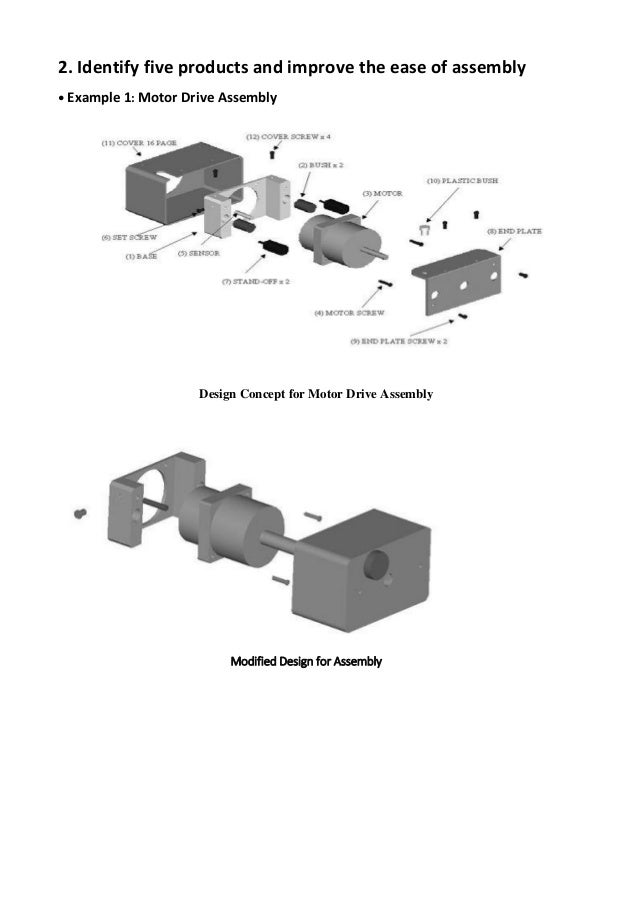
Continuous training programs can keep the design and manufacturing teams updated with the latest DFM techniques and tools. Training can range from workshops to courses and can even be a part of the organization’s knowledge-sharing platform. Incorporating features that make it impossible to assemble the product incorrectly can save time and reduce waste. This concept, also known as "poka-yoke" in Lean Manufacturing, helps to prevent errors before they occur. Take advantage of our special offer and receive a free prototype with your next production order.
Manufacturing
It’s the perfect opportunity to test your design and make any necessary adjustments before moving forward with mass production. It provides a much-needed edge for engineering companies in today’s competitive market. It is easy to overlook DFM due to the lack of information, but research and case studies have shown that the proper application of DFM principles can guarantee stellar results. Design for Manufacturing is a great way to save costs while delivering a premium product, but how exactly can companies get started with it?
Broaden DFM scope
For example, if a punch tool is made of the same grade of steel as the part it's used to perforate, it may stick and create galling, resulting in distortion of the hole and damage to the punch. Properly prepared designers should be fully familiar with every inherent property of each material which may be utilized in a design project. The better a designer's overall education regarding every type of design material, the faster, more efficient the design process. Designing half to a tenth of cost categories can avoid substituting cheap parts, which degrades quality, and encourages standardization and spontaneous supply chains, which will encourage Lean initiatives.
Material
Addressing manufacturing challenges proactively reduces the likelihood of defects and enhances the overall performance of the product. DFM encourages identifying and resolving potential manufacturing challenges early in the design process. Addressing these challenges preemptively results in products that are less prone to defects, inconsistencies, and assembly errors. This focus on quality contributes to improved customer satisfaction, reduced returns, and a more substantial reputation in the marketplace. In the present day, DFM is about optimizing traditional manufacturing processes and leveraging emerging technologies. Concepts such as additive manufacturing (3D printing), the Internet of Things (IoT), and artificial intelligence (AI) are influencing the way products are designed and manufactured.
OUTCOMES OF AN EFFECTIVE DFM
In particular, processes like surface-mount technology (SMT) and soldering are becoming more automated, generally lowering costs over the long term. Design for manufacturing (DFM), or design for manufacturability, is a set of practices for designing products that make them easy to manufacture. In particular, it allows engineers to address potential problems in the design phase where they’re less expensive to fix.
The book Computer-Aided Manufacturing offers 10 generally accepted Design for Manufacturing principles that were developed to help designers decrease the cost of and complexity of manufacturing a product. In industries producing electronics and consumer goods, DFM is crucial for designing products that are not only aesthetically appealing but also easily manufacturable. Efficient designs contribute to the production of smaller, lighter, and more feature-rich devices. Design and production are part of the same process, not mutually exclusive entities.
What is Design for Manufacturing or DFM?
Manufacturing Driven Design: Moving Beyond DFM - I-Connect007
Manufacturing Driven Design: Moving Beyond DFM.
Posted: Thu, 19 Oct 2023 07:00:00 GMT [source]
There are creative ways to engineer components with lower tolerances that still perform as well as ones with higher tolerances. Design for Manufacturability is the proactive process which ensures the quality, reliability, cost effective and time to market. Regularly review and analyze manufacturing processes to identify opportunities for further optimization. Iterative improvements based on real-world manufacturing experiences contribute to ongoing efficiency gains. Leverage advanced design software and simulation tools to model and analyze the manufacturability of product designs.
Design for Manufacturability Has Become Essential - ENGINEERING.com
Design for Manufacturability Has Become Essential.
Posted: Wed, 21 Sep 2022 07:00:00 GMT [source]
At times, the company may have to change the manufacturing process to meet certain specifications. The designers should set the loosest tolerances possible while meeting the functional requirements of the product. Using such tolerances reduces tooling costs and the number of defects, all while making the product easier to manufacture. DFM occurs early in product development, before tooling and the assembly process, when the product is being designed.
One of the company’s parts was returning all no-bids so they decided to analyze it using aPriori.aPriori showed an almost impossible undercut in the routing. This design feature ended up being a largely arbitrary choice and eliminating it reduced cost by over 50%. The new design was not only far more cost-effective but drew many more bids from potential suppliers.
“Design for manufacturability” is also known as “design for manufacturing,” or “DFM.” It is the process of designing a part or assembly with its manufacturing process in mind. The goal is to create a design that meets function and quality requirements, which can be produced in the easiest and cheapest way. DFM is the practice of optimizing the manufacturability of a part while maintaining its original design’s intentions.
Following these guidelines, the final product should be easier to manufacture and the production should take less time when compared to the original design. Optimizing designs for manufacturability accelerates the entire product development cycle. With reduced complexities and efficient manufacturing processes, products can reach the market faster, allowing companies to capitalize on opportunities and stay ahead of the competition. DFM contributes to significant cost savings by minimizing material waste, reducing production errors, and streamlining manufacturing processes. Efficient designs lead to lower production costs, contributing to a more competitive product in the market.
Reducing the total number of parts used and ensuring that they can easily be disassembled for repairs and maintenance all contribute to lowering the carbon footprint. On the other hand, design for manufacturability is a preemptive strike, creating products at the design stage that comprehensively lower the carbon footprint pre- and post-production. However vital, design for manufacturability is only one part of the puzzle when it comes to optimizing product costs and lowering the carbon footprint. Learn more about how to optimize product cost engineering for your organization.


No comments:
Post a Comment